
Cooking and baking
Turn an oven setting from a recipe written in °F into °C, or the other way round, without guessing.
Type a temperature, pick its scale and see all four scales at once. The formulas are shown in the guide, results can be copied one by one, and anything below absolute zero is flagged. Everything runs in your browser.
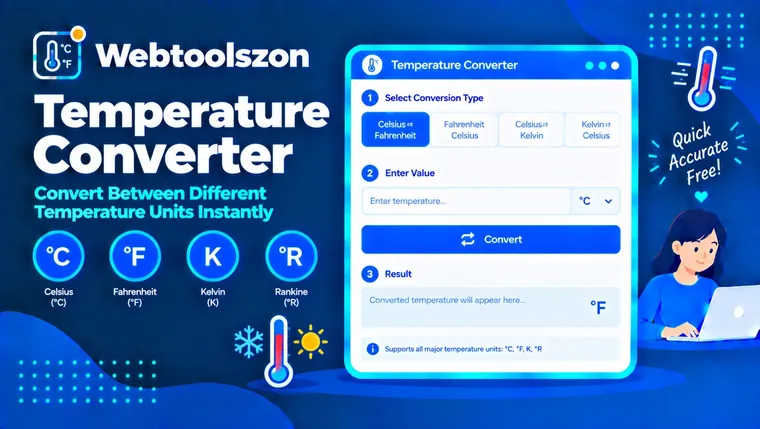
––––Learn the formulas and see where each temperature scale is used.
It changes a temperature from one scale to another. Celsius and Fahrenheit are the two everyday scales, Kelvin is the scientific one, and Rankine is the Fahrenheit-sized version of Kelvin used in some engineering work.
Type a value, pick the scale it is in, and all four results appear at once. That saves you from remembering which formula to use, and it warns you if the number is below absolute zero.
Turn an oven setting from a recipe written in °F into °C, or the other way round, without guessing.
Understand a forecast abroad. 30 °C is a hot day, while 30 °F is below freezing.
Check homework and lab data, especially Kelvin values used in physics and chemistry.
A quick mental shortcut from Celsius to Fahrenheit is to double the number and add 30. It is close for everyday temperatures, but use the formula when you need an exact answer.
| What | Celsius | Fahrenheit | Kelvin |
|---|---|---|---|
| Absolute zero | -273.15 °C | -459.67 °F | 0 K |
| Water freezes | 0 °C | 32 °F | 273.15 K |
| Cool room | 18 °C | 64.4 °F | 291.15 K |
| Room temperature | 20 °C | 68 °F | 293.15 K |
| Normal body temperature | 37 °C | 98.6 °F | 310.15 K |
| Hot summer day | 40 °C | 104 °F | 313.15 K |
| Water boils (sea level) | 100 °C | 212 °F | 373.15 K |
| Typical oven | 180 °C | 356 °F | 453.15 K |
Your values are converted in your browser. Nothing is sent to our server or stored. Only your scale and decimal choices are remembered on your device.
Results are shown to the decimal places you choose, so a very long decimal is rounded for display. Temperatures below absolute zero are rejected.
Multiply the Celsius value by 9/5 and add 32. For example, 25 °C is 25 × 1.8 + 32 = 77 °F. Type the value here and choose Celsius to see all scales at once.
Subtract 32 from the Fahrenheit value, then multiply by 5/9. So 98.6 °F becomes (98.6 − 32) × 5/9 = 37 °C.
Kelvin is the scientific temperature scale. It starts at absolute zero, 0 K, and one kelvin is the same size as one degree Celsius. It is used in physics, chemistry and astronomy.
Rankine starts at absolute zero like Kelvin but uses degrees the size of Fahrenheit. It appears mostly in some engineering fields in the United States.
They are equal at -40. That means -40 °C and -40 °F are the same temperature.
It is the lowest possible temperature: 0 K, -273.15 °C or -459.67 °F. The converter shows a warning if you enter anything colder.
Results use the number of decimal places you pick, from 0 to 6. Choose more decimal places if you need a finer answer.
No. The conversion runs in your browser and nothing leaves your device. Only your scale and decimal choices are remembered for next time.
The homepage features dozens more free tools that don't require an API key.
No matching question.
Share your thoughts on this tool with other visitors.