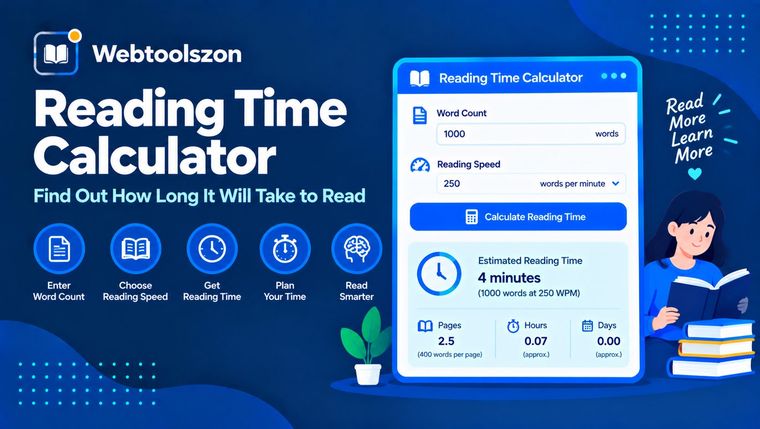
Reading Time Calculator
Find out how long it takes to read, speak, or narrate any text. Paste your article or enter a word count to get reading time, speaking time, and words-per-minute — instantly, and adjustable to your audience's actual reading speed.
Your text
Know your exact reading speed? Test it first with our Typing Speed Test, then dial in the presets below.
Reading & speaking time
How to calculate reading time
- Paste your article, blog post, or script into the box on the left.
- Adjust the reading-speed slider to match your audience — 200 words per minute is a reasonable default.
- Read off the estimated time, word count, and character count on the right, updated live.
Why reading time matters for content
An "X min read" label sets a reader's expectations before they commit to an article, and it's a useful gut-check for writers too — a post that estimates at 20 minutes might need trimming, or splitting into a series. It's also a practical way to time a script for a video or podcast segment before recording it.
The default of 200 words per minute reflects the commonly cited average adult silent-reading speed, but skimmable, list-heavy content is often read faster, while dense technical writing is usually read more slowly — the speed slider lets you account for either.
Typical reading speeds
| Reader type | Typical speed | Notes |
|---|---|---|
| Average adult, silent reading | ~200–250 WPM | Most common default for reading-time labels |
| Skimming a list or listicle | ~300–400 WPM | Scannable, low-density formatting reads faster |
| Dense technical or academic text | ~100–150 WPM | More time spent parsing unfamiliar terms |
| Reading aloud (for scripts) | ~130–160 WPM | Slower than silent reading due to pacing and breath |
How long does it take to read a given word count?
Skip the paste-and-scroll — if you already know the word count, switch the tool to "Enter word count" mode above. Here's how common lengths break down at a 200 WPM silent-reading pace vs. a 150 WPM speaking pace:
| Word count | Reading time (200 WPM) | Speaking time (150 WPM) |
|---|---|---|
| 500 words | ~2.5 min | ~3.3 min |
| 1,000 words | ~5 min | ~6.7 min |
| 1,500 words | ~7.5 min | ~10 min |
| 2,500 words | ~12.5 min | ~16.7 min |
| 5,000 words | ~25 min | ~33.3 min |
| 10,000 words | ~50 min | ~66.7 min |
Reading time calculator vs. speaking time calculator
Reading time and speaking time answer different questions from the same word count. Reading time estimates how long a silent reader needs to get through your text — useful for "X min read" badges on blog posts and articles. Speaking time estimates how long it takes to say the same words out loud, which is what matters for scripts, presentations, podcasts, and speeches. Because speech is paced by breath and articulation rather than eye movement, speaking time runs noticeably slower — this tool calculates both side by side, so you don't need a separate words-to-minutes calculator for scripts.
FAQ
Is this reading time calculator really free, with no sign-up?+
Yes. The tool runs entirely with JavaScript in your browser — there's no account, no API key, and no limit on how often you can use it.
What reading speed does this use by default?+
The default is 200 words per minute, the commonly cited average for adult silent reading, but the speed slider lets you adjust it anywhere from 100 to 400 words per minute.
Why would I change the reading speed?+
Reading speed varies by audience and content: technical or dense material is often read more slowly, while a skimmable list-style post might be read faster than 200 words per minute.
Does this account for images or embedded media?+
No, this calculates reading time from the word count of the pasted text only. Publishing platforms that add fixed seconds per image are estimating a separate factor on top of the base reading time.
Is this the same calculation used for "X min read" labels?+
It's the same general approach — words divided by a reading-speed constant, rounded up to the nearest minute — which is what most publishing platforms use for their reading-time labels. Use the "Copy 'X min read' badge" button above to grab that label directly.
How do I calculate reading time for a blog post?+
Divide the word count by your audience's reading speed, typically 200–238 words per minute for online readers. A 1,000-word post at 200 WPM comes out to about 5 minutes — this tool does that division for you and updates live as you type or paste.
What's the difference between reading time and speaking time?+
Silent reading is much faster than speech. Adults silently read around 200–238 words per minute, while speaking or narrating aloud runs closer to 130–160 words per minute, so the same text takes noticeably longer to say than to read — see the reading-vs-speaking breakdown above.
Can I calculate reading time from a word count instead of pasting text?+
Yes — switch to "Enter word count" mode above and type the total directly if you already know it, instead of pasting the full text.
Tools for Writers and Content Creators
How This Calculator Works
Your word count is divided live by the selected reading or speaking speed with JavaScript as you type or adjust the slider — nothing you paste is uploaded to a server or stored anywhere.
Last updated: August 28, 2026.
More tools in the box
Nine more free, no-API-key tools live on the homepage.
Typing Speed Test
Test your typing speed in words per minute with live accuracy.
GPA Calculator
Calculate a weighted GPA from courses, credits and grades.
Tip Calculator
Calculate the tip on a bill and split it between diners.
Text Reverser
Flip text backward, reverse word order, or reverse each word.
Duplicate Line Remover
Strip out repeated lines from any list or block of text.