JSON-formateringsverktøy
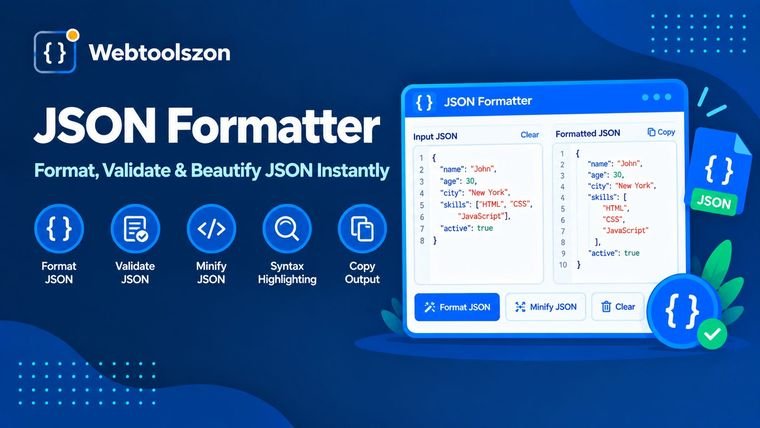
Beautify, minify and validate JSON right in your browser — with clear error hints when something doesn't parse.
Your JSON
Formatted output
Choose an indent, format your JSON, then copy or download the result.
Beautify pretty-prints with your chosen indent. Minify collapses everything to one compact line.
Anmeldelser
Everything you need to know about JSON Formatter
How to beautify, minify and validate JSON, how the indent options compare, and where formatted JSON is used.
- Paste JSON, pick Beautify or Minify, then copy or download the result.
- Everything runs in your browser — your JSON is never uploaded or stored.
- Use 2-space indent for readability, or Minify to shrink payloads for production.
How to use JSON Formatter
- Paste or type your JSON into the input panel, or click "Load sample" to try it out.
- Pick Beautify to pretty-print with your chosen indent, or Minify to collapse it to one compact line.
- Copy the formatted result to your clipboard, or download it as a standalone .json file.
Why format JSON at all?
Raw JSON from an API response, a log file, or a minified build config is often a single dense line with no line breaks, which makes it hard to read, debug, or diff. A missing comma or bracket can also break parsing entirely, and spotting exactly where is tedious by eye.
This tool re-indents JSON for readability, collapses it back down when you need a compact payload, and — because everything runs as plain JavaScript in your browser — points out exactly where parsing failed if your JSON isn't valid.
Beautify vs. Minify
| Mode | Best egnet for | Hvorfor det er verdt å sjekke |
|---|---|---|
| Beautify Recommended | Reading, debugging, code review | Indentation and line breaks make structure obvious at a glance |
| Minify | API payloads, production configs | Strips whitespace to reduce transfer size |
| Validate only | CI checks, quick sanity checks | Confirms syntax without changing formatting |
JSON Formatter without uploading your data
Everything happens on-device: your JSON is parsed and re-formatted using JavaScript's built-in JSON engine, right there in your browser tab. Nothing is sent to a server, logged, or stored — not even temporarily.
Because nothing uploads, there's no server-side file size cap. The only practical limit is your device's memory and browser performance for very large payloads.
Your JSON never leaves your browser. That makes it safe to paste in API keys, internal config, or other sensitive payloads while formatting them.
Need to compare two JSON files side by side afterward, or trim duplicate lines from a log export? The Duplicate Line Remover tool can help.
2 spaces vs. 4 spaces vs. tabs — which indent should you use?
| Indent | Best egnet for | Avveining |
|---|---|---|
| 2 spaces Good default | Web configs, API responses, most style guides | Deeply nested JSON can still get wide |
| 4 spaces | Matching a codebase that already uses 4-space indent | Wider output, more scrolling on deep nesting |
| Tab | Editors where you want indent width to be a personal setting | Renders inconsistently across tools/terminals |
If you're not sure, 2 spaces is the most common convention for JSON and keeps output compact without sacrificing readability. Switch to Minify entirely once you're ready to ship the payload.
What people use JSON Formatter for
- Debugging API responsesPretty-print a compact API response to actually read its structure.
- Validating config filesCatch a missing comma or bracket before it breaks a build.
- Shrinking payloadsMinify JSON before shipping it in a request body or static file.
- Reviewing pull requestsReformat a diff-unfriendly one-liner into something reviewable.
- Learning JSON structureSee nested objects and arrays laid out clearly while learning the format.
How This Tool Works
JSON Formatter runs entirely client-side using JavaScript's native JSON.parse and JSON.stringify, so formatting and validation happen instantly with nothing uploaded, stored, or logged.
Last updated: September 14, 2026.
Var denne veiledningen nyttig?
Flere verktøy i verktøykassen
Det finnes ytterligere fjorten gratis verktøy som ikke krever API-nøkkel på hjemmesiden.
Ordteller
Løpende telling av ord, tegn, setninger og avsnitt.
Bildeformateringsverktøy
Endre størrelsen på JPG-, PNG- og WEBP-bilder i piksler eller prosent.
Bilde til PDF
Slå sammen bildene til én enkelt PDF-fil som kan lastes ned.
Duplicate Line Remover
Strip repeated lines from any block of text.
Passordgenerator
Sterke tilfeldige passord med egendefinerte regler.